
Guest Post: M!RA Creative Tech for Cultural Heritage
Creative Director Jens Blank introduces the M!RA interactive content viewer.

Editor’s Note: I first had contact with Jens, author of this guest post, while I was working at sketchfab.com and I was hugely impressed with the digitisation work they had done for Staatliche Museen zu Berlin. It’s great to see them pushing online 3D even further with the M!RA platform!
Hello! We’re M!RA and Studio Blank. We create interactive experiences, storytelling, animation, and digitization projects all over the world. Our base is in Berlin.
The Path to 3D for Cultural Heritage
Our work in cultural heritage began with the Humboldt Forum in Berlin. Before the museum opened, we digitized masterpieces, primarily from their ethnological collection. This was done to archive the exhibits and to produce a variety of materials for their marketing, including renderings for print and web, animations for screens and conferences, and the foundational assets for interactive applications.
Since then, we’ve expanded our focus, applying our expertise to digitize not just individual objects but entire exhibitions and museums. Notable projects include the James Simon Gallery and a 2000sqm wing of the Pergamon Museum which, facing a 15-year closure for extensive renovations, can now be explored via a 3D experience.


What Drives Us
The merger of cutting-edge technology with artifacts from our past. This relationship provides fresh perspectives and new angles. Having initially worked in advertising, we find beauty in a job that’s similar in structure, yet instead of promoting a snack, we’re essentially helping to promote knowledge about history, art, and so much more.
Try M!RA and learn more about our work:
About M!RA
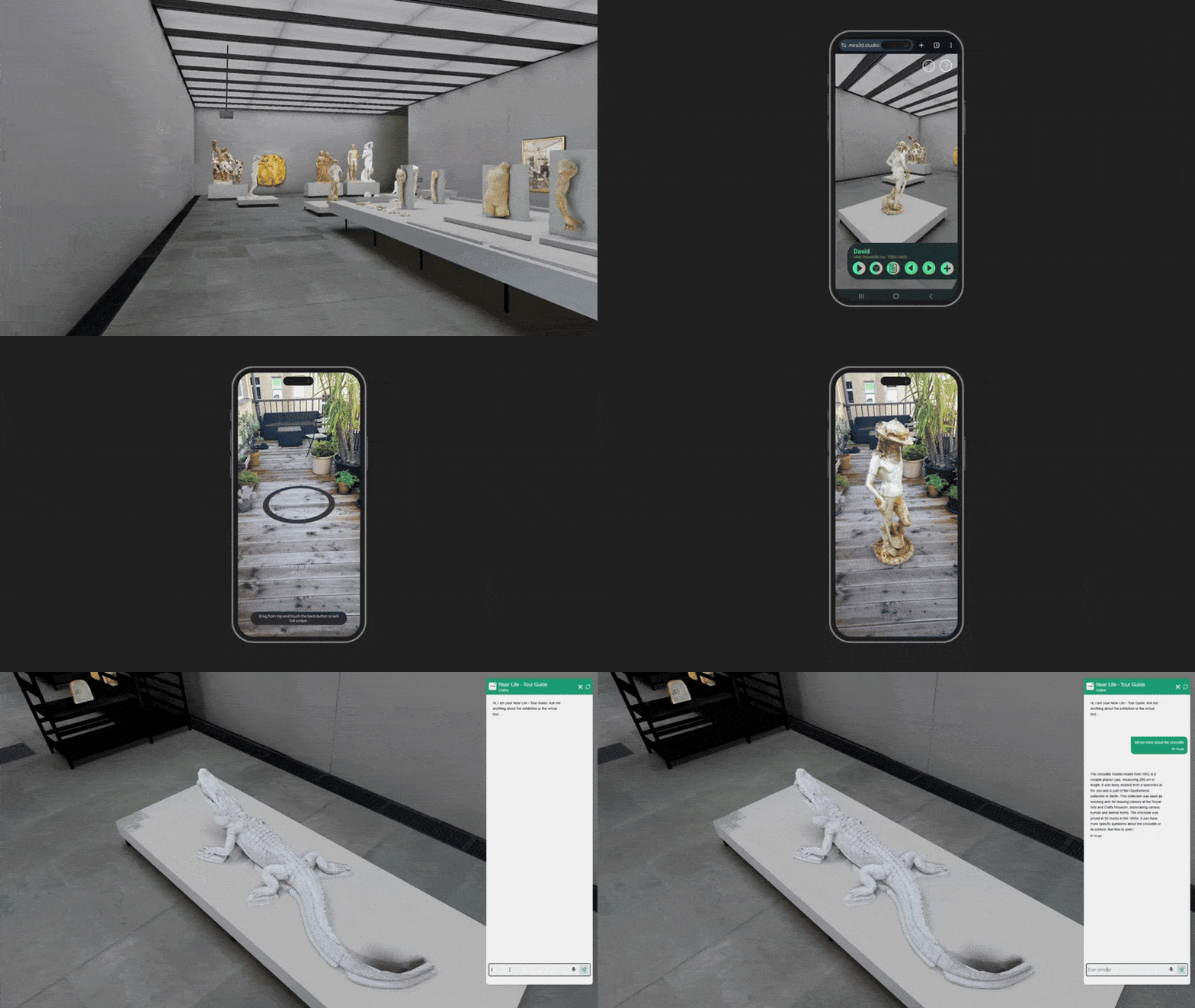
The primary goal is to enable launching an interactive experience within a couple of days, rather than spending weeks or months on development. In cultural heritage digitization, we often observed that only a fraction of scanned content made it into a final application. Resources for interaction were typically stretched thin, and projects often required expensive, laborious custom solutions built from the ground up. We realized it was time to build a framework “M!RA” where we could efficiently integrate 3D data, combine it with other assets like text, audio, videos, images etc. and deliver a smooth experience on both mobile and desktop devices within a very short timeframe.


The Power of 3D Technology
Once the 3D assets are prepared and integrated into M!RA, we can provide an experience that is as close as possible to being in the actual location. Only 3D can achieve this: giving users a sense of space through a human lens, with the freedom to move around, rather than viewing everything via pre-curated 2D content.
Everyone has their own way of experiencing an exhibition. M!RA reflects that too: visitors can either explore the 3D space on their own or be guided through the exhibition - accompanied by an Agentic RAG chatbot acting as their tour guide.
Furthermore, with the recent advent of gaussian splatting, the potential for scanned 3D content will play an increasingly vital role.
We use the standard tools for capture and creation: drones, cameras, LiDAR, ring flashes and lights, Blender, various game engines, a bunch of custom scripts and plugins and a vast amount of storage space. You can learn more at mira3d.studio.
Future Plans
Our plan is to create a versatile platform that not only carries visual content but also helps develop the storytelling and educational potential of digital media. We aim to tailor experiences that aren’t primarily designed for the stereotypical museum visitor, but rather bring our history closer to people from all sorts of backgrounds.
Currently, we often just create a 1:1 reproduction of existing buildings and surroundings. We copy entire real-world exhibitions, including their contextual content, and recreate them as-is in the digital space. We believe there’s much more potential here. This could involve what some call gamification or simply a greater willingness to experiment with new ways of engaging with audiences, especially young people.
Generally we hope that cultural heritage becomes more accessible to everyone, everywhere.
Paying it forward…
Editor’s note: While they’ve got your attention, I ask contributors to share a link to something that they think Spatial Heritage Review audiences should know about :)
While it is not strictly a cultural heritage project I highly recommend checking out MANIFEST:IO Symposium for New Media + Electronic Art. One of the most seamless and exciting combinations of culture, art and education that I got to experience in a long time. - recommended!
 | A guest post by
|